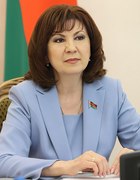
Delegation of the National Assembly of the Republic of Belarus to the CSTO PA consists of 7 deputies from the House of Representatives of the National Assembly of the Republic of Belarus and 4 deputies from the Council of the Republic of the National Assembly of the Republic of Belarus.
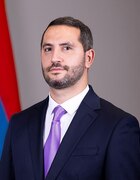
Plenipotentiary representative of the National Assembly of the Republic of Belarus: Viktor Kogut
Website of the House of Representatives of the National Assembly of the Republic of Belarus: http://house.gov.by/en/
Website of the Council of the Republic of the National Assembly of the Republic of Belarus: http://www.sovrep.gov.by/ru/
The delegation of the Kurultai of the Republic of Kazakhstan to the CSTO PA is represented by 6 deputies.
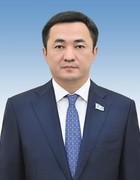
The head of the delegation is Aybek Dadebai, Chairman of the Kurultai of the Republic of Kazakhstan.
Deputation:
ADAMBEK Kendebai
KUSPEKOV Olzhas
RAKHIMZHANOV Askhat
KEMALOV Meirambai
KOZHAEV Marat
KUCHINSKAYA Yulia
Plenipotentiary Representative of the Parliament of the Republic of Kazakhstan, deputy Executive Secretary of the CSTO Parliamentary Assembly: Viktor Rogalev
Website of the Kurultai of the Republic of Kazakhstan: https://quryltai.kz/
Delegation of the Supreme Council of the Kyrgyz Republic to the CSTO PA consists of 6 deputies.
AKIMBAYEVA Gulnara
ALIMZHANOVA Nilufar
JALILOV Azamzhan
KOZUYEV Alisher
UZAKBAEV Ulukbek
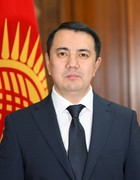
Plenipotentiary Representative of the Supreme Council of the Kyrgyz Republic: Nurbek Satvaldiev
Website of the Supreme Council of the Kyrgyz Republic: http://www.kenesh.kg/
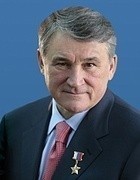
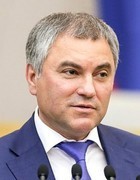
Delegation of the Federal Assembly of the Russian Federation to the CSTO PA is represented by 10 deputies of the State Duma of the Russian Federation and 12 senators of the Russian Federation.
Plenipotentiary representative of the Federal Assembly of the Russian Federation - deputy Executive Secretary of the CSTO Parliamentary Assembly: Mikhail Krotov
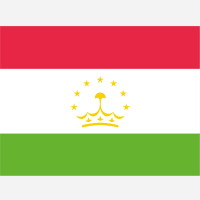
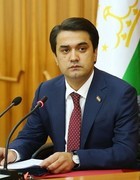
Delegation of the Supreme Assembly of the Republic of Tajikistan to the CSTO PA consists of 6 deputies of the National Assembly of the Supreme Assembly of the Republic of Tajikistan and 6 deputies of the Assembly of Representatives of the Supreme Assembly of the Republic of Tajikistan.
IGOR SERGEYENKO: MODERN REALITIES COMPEL US TO RESPOND TO ENTIRELY NEW TYPES OF THREATS
15 April 2026
IGOR SERGEYENKO: MODERN REALITIES COMPEL US TO RESPOND TO ENTIRELY NEW TYPES OF THREATS
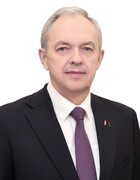
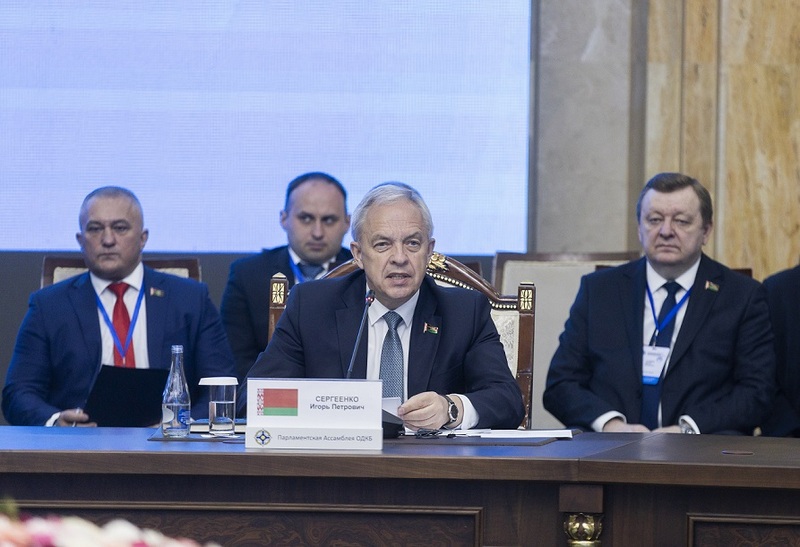
Interview with Igor Sergeyenko, Chairman of the House of Representatives
of the National Assembly of the Republic of Belarus
on the occasion of the 20th anniversary of the CSTO Parliamentary Assembly
Mr. Sergeyenko, how effectively is Belarus’ strategic goal being implemented in regional initiatives related to the CSTO Parliamentary Assembly’s work?
To put it short, very effectively. But let’s forego general declarations and look at the specifics. Republic of Belarus has always viewed the CSTO not merely as a dialogue forum, but as a real, functioning mechanism—the most important guarantor of our national and regional security. The strategic goal of Belarus within the framework of the Parliamentary Assembly is completely pragmatic: we are forming a single legal “shield” that allows the Organization’s Member States to collectively and promptly respond to modern threats.
What does this look like in practice? Over the 20 years of the CSTO PA’s work, we adopted more than a hundred model laws and recommendations, and the Belarusian delegation consistently acts as the driving force behind the most relevant of them. We don’t wait for the challenge to arise; instead, we anticipate and prepare for it. In recent years, Belarus has emerged as one of the primary initiators of model legislation on information and biological security, as well as the protection of electoral sovereignty and countering the color revolution technologies. The national legislation of our countries is currently being harmonized according to these standards.
A prime example of a successful strategy was Belarus’ chairmanship of the CSTO in 2023 under the motto “Through Solidarity and Cooperation Toward Peace and Security.” It was not just a catchy slogan, but a real roadmap for action.
And now, during the Russian Federation’s chairmanship, we are translating the global peacekeeping vision into practical parliamentary decisions. Our initiatives—from joint statements at international forums to the harmonization of criminal legislation in combating extremism—are met with full support from our CSTO allies. This is the main measure of the strategy’s success.
In your opinion, which jointly developed CSTO model draft law proposals are the most relevant?
We are currently working within the framework of the CSTO Parliamentary Assembly’s 2026–2030 Action Plan on Approximation and Harmonization of National Legislation; the modern realities compel us to respond to entirely new types of threats—hybrid and high-tech in nature.
Speaking of the key priorities for the near future, I would like to mention several areas.
First, information and cybersecurity. Today, wars begin on smartphones and servers. We urgently need to standardize protection of critical information infrastructure—our power grids, transportation systems and communications networks. We have also initiated the development of legal mechanisms to counter destructive influence on the Internet. This involves accountability for the use of artificial intelligence to create disinformation, information terrorism, and attempts to undermine society from within through social media.
Second, biological security. The pandemic was the wake-up call. We and our allies are concerned about the unsupervised activities of third-country military and biological laboratories, which are closely encircling the borders of the CSTO Member States. We need strict laws, harmonized at the Organization level, to ensure sanitary and epidemiological sovereignty and control over the circulation of dangerous pathogens.
Third, combating terrorism, extremism and drug trafficking. Recent tragedies show that the recruitment of terrorists and coordination of sleeper cells have moved to messaging apps and the dark web. CSTO parliamentarians must update model legislation so that the intelligence services of our countries have a reliable legal basis for promptly curbing the financing of terrorism through cryptocurrencies and eliminating synthetic drug supply channels.
And finally, a fundamental matter: protection of historical memory and traditional values. Last year, we celebrated the 80th anniversary of the Great Victory with dignity, and we continue building a barrier against the madness unfolding in a number of Western countries. We have already put serious effort in model laws that impose strict liability for the glorification of Nazism, the distortion of historical truth and the promotion of non-traditional values, foreign to our peoples. This is a matter of spiritual sovereignty of our states.
Last year, cooperation between parliamentarians and youth, educational and expert platforms within the CSTO Parliamentary Assembly was particularly relevant. In what areas will the Organization work with young people in the future?
Let’s be frank: today, a real cognitive war is unfolding in the world—a battle for young people’s minds. These are the people who will soon govern our states and ensure their security.
For the immediate future, we have identified three very specific areas of work. First is the preservation of historical memory as the conerstone of our identity. Against the backdrop of the West’s attempts to rewrite history, our youth must become the main advocates for historical truth. We expect young parliamentarians and experts to launch joint initiatives to develop search movements, digitize archives and create joint memorial projects.
Second, building up information resilience. Today’s youth lives in a digital environment, and that is precisely where our opponents’ main information and psychological operations are aiming. Our task is to teach young leaders to handle the information battle themselves, both at the legislative level and by defending national interests with sound arguments on social media.
Third, engaging young minds in practical analysis. We urgently need a fresh, unconventional perspective on collective security issues. We have already started actively involving young political scientists, lawyers and IT specialists in the work of CSTO PA Council’s Expert Advisory Board and will scale up these successful formats. We need fresh ideas on combating cybercrime, extremism and drug trafficking, as well as on other no less pressing issues.
Our main goal is simple: we want young people from Belarus, Kazakhstan, Kyrgyzstan, Russia and Tajikistan to have a clear understanding that we are allies. We share a great history, and only together can we build a safe future.
CSTO parliamentarians have continuously monitored the elections in the Republic of Belarus and other CSTO Member States. Members of the House of Representatives regularly participate in these missions. What principles and criteria do you see as particularly important in this work?
Let’s face the facts: today, elections in our countries have transformed from a strictly internal democratic procedure into a target for unprecedented external pressure and attempts at destabilization. In these conditions, monitoring electoral campaigns through the CSTO Parliamentary Assembly has become a vital tool for defending our sovereignty.
Participating in these missions, members of the House of Representatives strictly adhere to three basic principles that makes our approach fundamentally different from the work of some Western structures.
The first and foremost principle is absolute respect for electoral sovereignty. We firmly believe that elections are held for the citizens of a specific country, not for reporting to foreign centers. Notable examples are the presidential elections in the Russian Federation and the Republic of Belarus, parliamentary elections in Tajikistan and Kyrgyzstan, and the recent constitutional referendum in Kazakhstan. CSTO PA observers see firsthand that our peoples determine their own future themselves, in a calm and secure environment, firmly quashing any attempts at external dictates.
The second principle is strict objectivity and relying on law, not on politics. Belarusian parliamentarians assess the actual situation: how the commissions operate, whether the secrecy of the vote is ensured, and to what extent the process complies with the national legislation of a certain sovereign state, rather than with contrived abstract concepts.
The third principle is firmly rejecting double standards and focusing on constructiveness. Our goal is not to act as inquisitors, nor to meticulously search for artificial flaws for the sake of sensational statements. CSTO PA missions work toward constructive outcomes. We provide a fair assessment of the transparency and legitimacy of the process, and, most importantly, we exchange best lawmaking practices. Ultimately, the conclusions of the CSTO PA missions serve as a kind of “quality stamp” that protects our countries’ electoral systems from international discredit.
How would you assess, overall, the role of the House of Representatives in interparliamentary cooperation within the new realities of international dialogue? What are the key tasks for the parliamentarians in this regard?
Today, traditional diplomacy is often constrained by the pressure of sanctions, the language of ultimatums, and artificial barriers built by the collective West. And under these conditions of unprecedented collapse of the old system of international relations, the role of parliamentary diplomacy is growing exponentially.
While officials and diplomats are constrained by rigid protocol, parliamentarians, as the people’s elected representatives, have a mandate for a more open, direct and pragmatic dialogue. Today, the House of Representatives is not merely a participant in international meetings, but an active player on the international arena, breaking through the information blockade and conveying the truth about Belarus.
Speaking of the key tasks of our parliamentarians, I would underline the following strategic priorities. First, consolidating our immediate sphere of integration. This is an unconditional priority: providing legal support for the implementation of union programs with the Russian Federation. At the same time, we must work as closely as possible within the framework of the CSTO Parliamentary Assembly, the IPA CIS and the Parliamentary Assembly of the Union of Belarus and Russia on issues of economic security and technological sovereignty, so that no external sanctions can undermine our economies.
Another priority is shifting toward the countries of the Global Majority. The world no longer revolves around the West. In 2024, a historic event took place: the Republic of Belarus became a full member of the Shanghai Cooperation Organization (SCO). Close cooperation with BRICS is also on the agenda. The task of our parlamentarians is to convert this political success into real economic benefits by establishing a reliable legal foundation with countries in Asia, Africa and Latin America, and strengthening our unconditional strategic partnership with China and other friendly nations.
Of course, we keep actively promoting peace initiatives. While our western neighbors are literally erecting reinforced barb wire fences along our borders, Belarusian parliamentarians are calling for dialogue at all international forums. Our position remains unchanged: parliamentarians must build bridges for trade and cooperation, not walls of division. And this constructive voice of Belarus is being heard ever more clearly now in the world.
What would you wish the parliamentarians and the expert community involved in the work of the CSTO Parliamentary Assembly for this anniversary year?
In this momentous year, I want to stress the most important point: 20 years is not just a nice round date or an occasion for celebratory speeches. It is a serious milestone that speaks of our resilience. Over the years, many skeptics in the West have repeatedly predicted a crisis for our Organization, but the CSTO PA has proven its viability in practice by developing a solid body of model legislation—our reliable legal shield.
Therefore, to Vyacheslav Volodin, Chairman of the CSTO Parliamentary Assembly, to all my fellow parliamentarians from the CSTO countries, to the CSTO PA Secretariat staff in St. Petersburg who work tirelessly every day, and to our esteemed expert community, I wish not only inexhaustible energy, but true courage, sharp thinking, and foresight to stay one step ahead, identifying hybrid threats even before they enter an active phase, as well as uncompromising determination and firmness in defending the sovereign interests of our states at all international forums.
May the 20th anniversary of the Parliamentary Assembly serve as yet another starting point for building a new, just architecture of Eurasian security.
I wish our countries and peoples something that has become the most important in today’s world: a peaceful sky. As Aleksandr Lukashenko, President of the Republic of Belarus, has stressed many times, only by staying united and demonstrating genuine, not merely declarative allied solidarity can we protect our collective home from any historical turbulence.
 RU
RU